
Discover key insights into the labor market for frontline and essential workers. Analyze trends, wages, schedules, and the impact of economic changes to help you attract and retain top talent.
ExploreThe frontline job market is shifting as employers demand higher skills and qualifications, reshaping hiring practices.
• Job postings are rising, while resume submissions are declining, but the overall supply of workers is still up YoY. This could indicate a softening of the market as opposed to a full-on tightening.
• Wages have increased steadily, reflecting compensation for higher qualifications, yet highlighting the challenge of attracting talent in a softening market.
• “No degree required” and entry-level job indexes, which indicate the number of entry-level jobs not requiring a degree or experience, are trending downward. This points to a trend towards pickier employers, widening the gap between available workers and job requirements.

To explore Talroo’s data and search findings for recruiting and hiring, use the Industry Explorer below. You can view nationwide trends or focus on specific states. Additionally, you can narrow your search by selecting industries or specific job titles. Happy searching!

The Frontline Worker Index (FWI) provides valuable data on key factors like supply and demand, job titles, wages, work schedules, education and experience requirements, and the benefits frontline workers value most. By analyzing these insights, HR professionals and recruiters can develop more effective strategies for attracting, hiring, and retaining top talent in today’s highly competitive job market.
The FWI compares new resumes and new job posts to show the balance between job seeker supply and employer demand.
April's trend of rising resumes and fewer job postings has shifted to the opposite scenario in June and July 2024—where resumes have declined and job postings have increased—suggests a softening labor market. What does this mean?
Overall Implications:
These contrasting trends underscore the fluid nature of the labor market, emphasizing the importance for both employers and job seekers to remain flexible and responsive to evolving conditions.
Despite this being the general trend, there are some industries that are resilient, according to Talroo data. Hospitality and Food Services don’t seem to be seeing the same indexing, and thus are less likely to be impacted by a resume shortage.
Continuing the discussion on supply and demand from the graph above, this section shows the demand from frontline job seekers using Talroo-associated job boards and search engines, and the supply, which consists of job posts from employers advertising through Talroo.
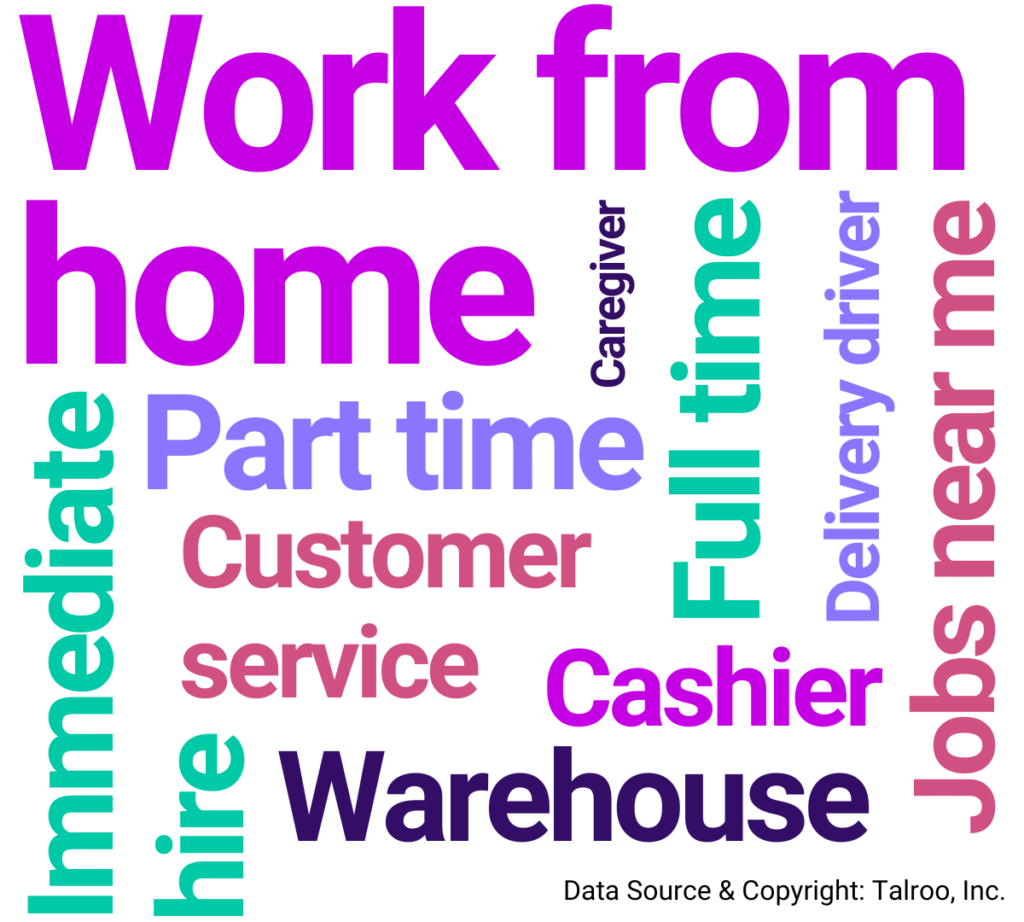

Half of the top job searches on Talroo-associated job boards and search engines relate more to how frontline and essential workers want to work than what they want to do. This falls in line with what we’ve seen through all our index reports, although the percentage has dropped slightly. And much like April and June’s findings, there’s a correlation between the top searches and the top job titles: the majority include information that pertains to not just what the job will be, but how the work will be.
And despite the fact that Work from Home remains the top query in Talroo-associated job boards and search engines, that index has continued to drop, showing it is less of a priority for employers, which will be discussed more in the Schedules, Hours, & Remote Work section.
Companies that clearly outline what frontline and essential workers want in job descriptions are more likely to attract qualified candidates who fit well with their workplace culture and values.
This dataset shows the average wage and sign-on bonus for all jobs listed on the Talroo Ad Platform. Because of salary transparency laws in various states, some states are more represented in the map and final numbers than others.
For example, states like California and New York, which have strict salary transparency laws, provide more detailed data, potentially pushing overall averages higher. On the other hand, states with fewer or no transparency requirements might have fewer job listings, leading to less data representation in the overall dataset.
Additionally, the sign-on bonus index only includes jobs that specifically mention a starting bonus. You can find the percentage of jobs offering a bonus in Talroo’s ecosystem under the “Offers Bonus” section.
When reviewing this table, keep in mind that wages are reflective of experience and other requirements as well, and the increase in wages corresponds with an increase in experience as well as less remote work.
HR professionals and recruiters can use this dataset to improve their hiring strategies. Here are three actions they can take:
This dataset shows the indexed Work from Home, Part-Time, and Full-Time positions listed by clients on the Talroo Ad Platform. It's important to note that some positions may be listed as part-time or full-time based on availability or store needs, but this doesn't necessarily affect the overall numbers.
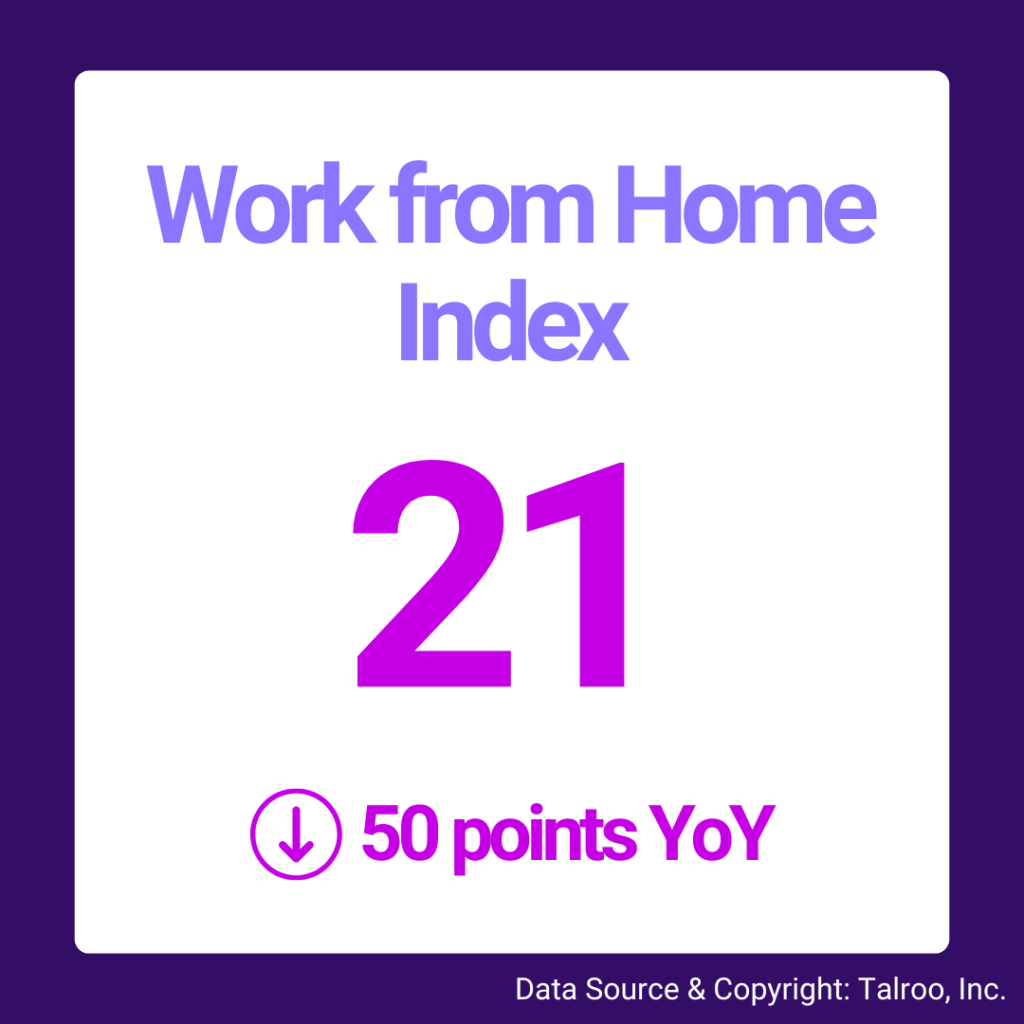
The trends in the Remote Work or Work from Home index match the "Return to the Office" movement.
This shift shows a growing focus on in-person roles as businesses emphasize on-site operations and face-to-face interactions.
HR professionals and recruiters should be aware of the Work from Home Index, Part-Time Index, and Full-Time Index specific to their industry, the roles they’re hiring for, and their state. Here are three important reasons why:
This index includes Talroo clients who list jobs that don't require education or experience. For example, a cashier position that doesn't need a high school diploma or prior experience would be part of this index.
Both indexes have continued to decline since March 2023, with the “No Degree Required” index dropping by five points and the “No Experience Required” index dropping by two this month.
This may be influenced by several factors:
Explore the graphs below to see how these requirements vary across different states or industries:


HR professionals and recruiters can stay ahead with these strategies:
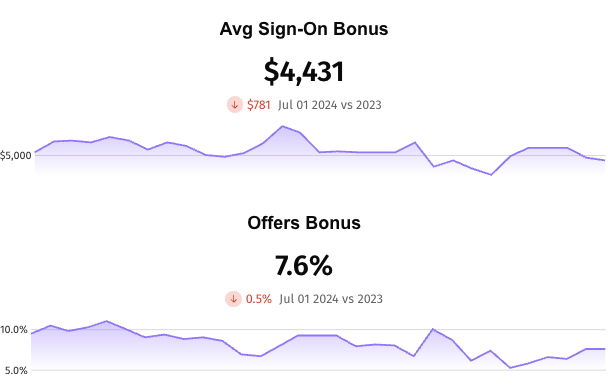
Frontline and essential workers play a critical role in keeping many industries and services running smoothly. Understanding the key benefits they value is essential for successful recruitment and retention. The following image shows the average sign-on bonus for positions in the Talroo ecosystem, as well as the percentage of positions that offer a sign-on bonus.
As you can see, the average sign-on bonus has dropped almost 18% since July 2023, and the number of jobs in Talroo's ecosystem that are offering bonuses has dropped by 0.5%. What this means for the industry:
Let’s delve into the current trends in the labor market, focusing on the growing mismatch between job openings and resume postings. Using insights from recent reports and data from the Bureau of Labor Statistics, we provide a detailed analysis of how these trends are influencing various industries and the broader labor market.
The ongoing mismatch between job supply and candidate demand presents challenges for both employers and job seekers. Employers may face heightened difficulties in filling roles, particularly as more workers consider leaving their current positions. On the other hand, job seekers, particularly those in frontline and essential roles, may find themselves in a stronger negotiating position as demand for labor increases and supply remains tight.
The current labor market trends emphasize the need for adaptability and proactive strategies from both employers and job seekers to navigate the evolving landscape effectively. As the "Great Resignation 2.0" looms, staying informed and prepared will be key to success in 2024.
External Sources: Bureau of Labor Statistics, Bloomberg, Resume Builder
To explore Talroo’s data and search findings for recruiting and hiring, use the Industry Explorer below. You can view nationwide trends or focus on specific states. Additionally, you can narrow your search by selecting industries or specific job titles. Happy searching!
View the latest FWI Report here →
View the June 2024 FWI Report here →
The Frontline Worker Index (FWI) is a comprehensive tool designed to provide insights into the labor market dynamics for frontline and essential workers exclusively. This report analyzes trends in supply and demand, job titles, wages, work schedules, education and experience requirements, and valued benefits. By examining these critical metrics, HR professionals and recruiters can develop effective strategies to attract, hire, and retain top talent in a competitive job market.Talroo processes an average of 26 million job posts every month, with over 187 million data points adding to this index directly. This extensive dataset is sourced first-party directly from Talroo, reflecting a broad spectrum of industries and geographic locations. Some job posts are comprehensive while others are less detailed; our goal is to encourage companies to be more transparent and intentional with their job posts to improve data quality and utility.The FWI reflects information from a wide range of sectors, powered by Talroo’s robust dataset and supplemented with Public Insight Data. The report includes detailed graphs and data points, offering a clear view of how different industries are managing tight labor markets and legislative changes for frontline roles. It’s important to note that our data does not reflect all positions equally; some job posts may represent a need for one hire, while others might represent a need for 1,000.Index numbers are based on January 2022, a point of relative stability in a post-pandemic world for frontline workers.This set of indices is an invaluable resource for HR professionals, recruiters, business leaders, and investors seeking to understand and navigate the complex landscape of frontline and essential workforces. It provides actionable insights that can help benchmark past and current performance, as well as forecast near-term industry trends and outlook.


