
Discover key insights into the labor market for frontline and essential workers. Analyze trends, wages, schedules, and the impact of economic changes to help you attract and retain top talent.
ExploreThe frontline labor market is experiencing pivotal changes this month, with notable shifts in wages, job postings, and the balance between remote, part-time, and full-time work.
• Supply & Demand: For the first time in five months, resume postings surged while job postings declined.
• Wages & Pay: Wages continue to rise, especially in healthcare, with significant increases in hourly pay and sign-on bonuses.
• Schedules, Hours, & Remote Work: Full-time roles are growing, while part-time opportunities are sharply declining, indicating a preference for stable, full-time staffing. Remote work is down overall, but industries like hospitality and retail are seeing a marked increase in remote roles.

To explore Talroo’s data and search findings for recruiting and hiring, use the Industry Explorer below. You can view nationwide trends or focus on specific states. Additionally, you can narrow your search by selecting industries or specific job titles. Happy searching!
As 2024 draws to a close, two critical trends are shaping the frontline workforce landscape: the ongoing struggle to retain healthcare workers in the face of high turnover, and the preparations that industries like retail and hospitality are making for the fast-approaching holiday season. These trends not only underscore the challenges of maintaining a stable workforce in essential sectors but also reflect the intensifying competition for seasonal employees.
The healthcare industry continues to grapple with significant turnover, especially among nurses and other frontline professionals. With the demand for healthcare services rising steadily, organizations are focusing their retention efforts on compensation, career development, and mental health support to keep their workforce intact.
In healthcare, balancing competitive wages with non-monetary benefits like professional development and mental health support is becoming increasingly vital for retention. As wages rise and the labor market tightens, employers will need to refine their strategies to maintain a qualified, stable workforce.
With the holiday season looming, industries like retail, hospitality, and even healthcare are preparing for an influx of demand. Seasonal workers are essential to meet this surge, but attracting and retaining them has never been more challenging. Employers face stiff competition for talent, pushing wages higher and forcing businesses to adopt new strategies to attract workers.
As competition for seasonal workers intensifies, businesses are relying on higher wages, flexible hours, and a supportive work culture to attract and retain talent. The slight rise in the No Experience Required index reflects that companies are casting a wider net, though finding skilled seasonal workers remains a challenge.
These evolving trends highlight the shifting dynamics in both the healthcare and frontline sectors, as organizations balance the immediate need for seasonal support with long-term workforce stability.
External Sources: Advisory Board, Broadleaf, Axonify

The Frontline Worker Index (FWI) provides valuable data on key factors like supply and demand, job titles, wages, work schedules, education and experience requirements, and the benefits frontline workers value most. By analyzing these insights, HR professionals and recruiters can develop more effective strategies for attracting, hiring, and retaining top talent in today’s highly competitive job market.
The FWI compares new resumes and new job posts to show the balance between job seeker supply and employer demand.
This month, for the first time in five months, the labor market has flipped, with the Resume Posting index surging by 53 points while the Job Posting index dropped 80 points.
Most impacted industries:
Building on the supply and demand insights from the previous graph, this section highlights the demand from frontline job seekers using Talroo-associated job boards and search engines. On the supply side, it examines job postings from employers advertising through Talroo, giving a clear picture of the current job market dynamics.
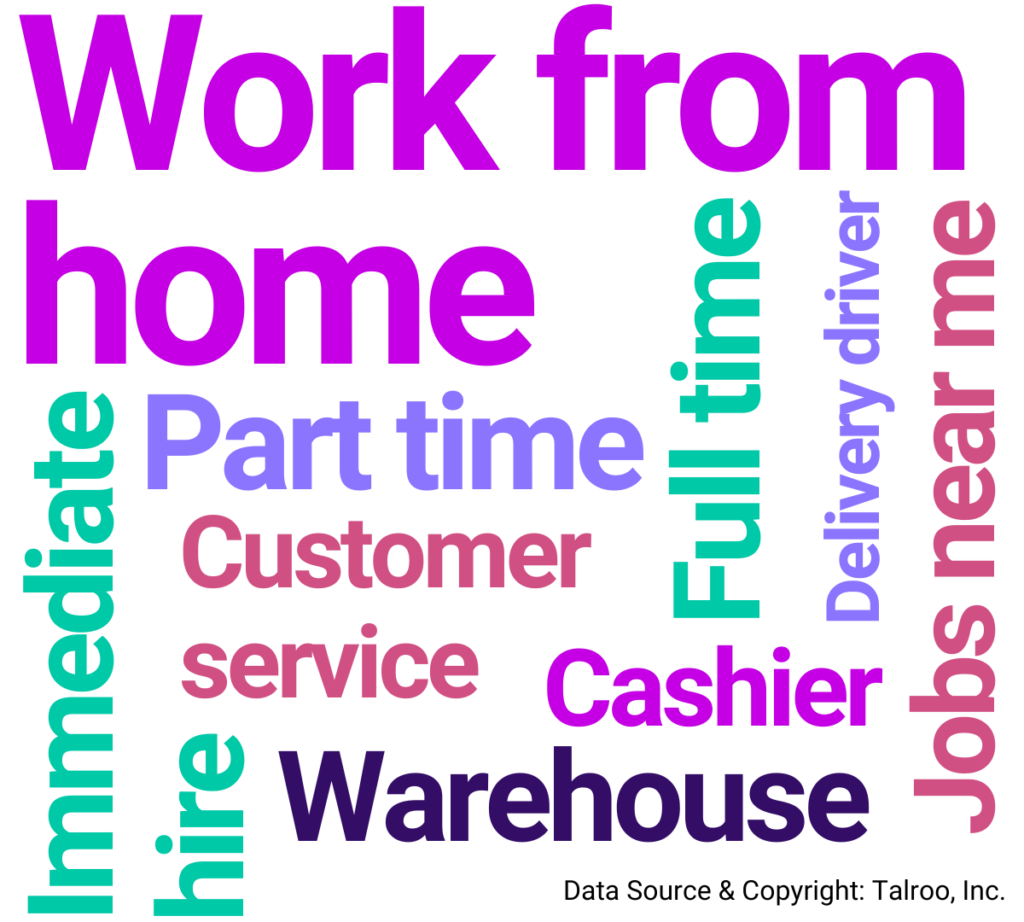

Over half of the top job searches on Talroo-associated platforms are now centered around how frontline and essential workers want to work, rather than what specific jobs they’re after. This trend is in line with previous index data, though we’re seeing a slight increase in the focus on work conditions. While "Work from Home" is still the most common search, its importance is gradually fading, showing that it's less of a priority for employers. Companies that clearly communicate what workers are looking for in job descriptions are more likely to attract the best-fit candidates.
This dataset shows the average wage and sign-on bonus for jobs listed on the Talroo Ad Platform, and reflects significant regional discrepancies in states like California and New York. These states with strict salary transparency laws may skew the average wage data. In contrast, states with fewer transparency requirements remain underrepresented.
The featured hourly wage has increased by $3.33 year-over-year and $1.71 month-over-month, with healthcare playing a major role. Allied Health positions offer the highest average hourly wage at $39.17, while the overall average excluding healthcare is $18.72, showing modest gains of $0.41 year-over-year and $0.97 month-over-month.
Sign-on bonuses surged $2,024 month-over-month, though the percentage of jobs offering these bonuses has dropped by 1%, signaling that fewer companies are offering bonuses but in larger amounts to attract seasonal workers ahead of the holiday season. Higher wages continue to align with roles requiring more experience and offering less remote flexibility.
This dataset shows the indexed Work from Home, Part-Time, and Full-Time positions listed by clients on the Talroo Ad Platform. It’s important to note that some positions may be listed as part-time or full-time based on availability or store needs, but this doesn’t necessarily affect the overall numbers.
This month’s data shows significant shifts in part-time, full-time, and remote work trends. The following bullet points summarize these changes and their impact across industries:
These trends illustrate how the workforce landscape is changing post-pandemic, with a clear preference for full-time, in-person work across most sectors. However, industries like hospitality and retail are increasing their remote roles, driven by the rise of digital services and online customer interactions. Meanwhile, sectors like warehousing and logistics remain reliant on on-site workers, with remote work opportunities continuing to decline.
This index tracks Talroo clients who post jobs that do not require formal education or previous work experience. For example, roles such as warehouse workers or food service employees often fall into this category.
Both the No Degree Required and No Experience Required indices have experienced declines over the past month. The No Degree Required index dropped by 5 points, and the No Experience Required index fell by 1 point year-over-year, though it saw a 2-point rise month-over-month. These trends suggest that more employers are requiring degrees or experience for frontline jobs, possibly indicating a shift towards more stringent hiring criteria as businesses seek candidates with stronger qualifications.
Explore the graphs below to see how these requirements vary by state or industry:


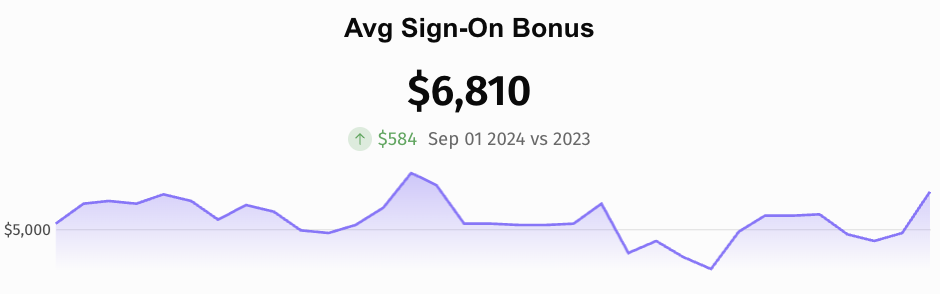
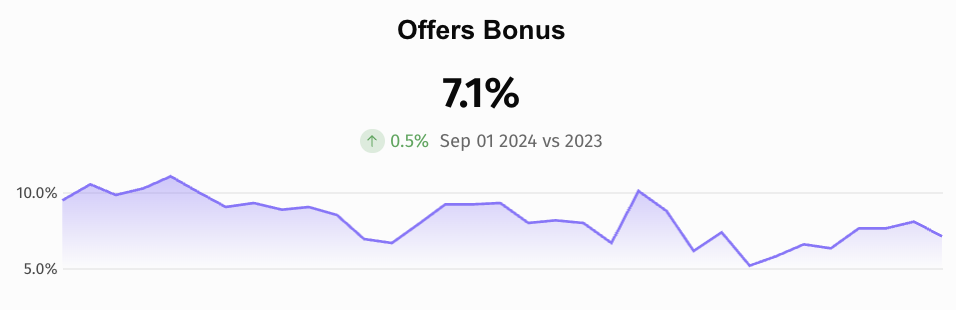
This index tracks the average amount of sign-on bonuses offered and the percentage of companies providing them. Bonuses are a key incentive, especially for frontline workers in industries like retail, healthcare, and logistics.
This month, the average sign-on bonus has surged by $2,024 month-over-month, indicating increased efforts to attract talent as companies prepare for the busy holiday season. However, the percentage of companies offering sign-on bonuses has dropped by 1% month-over-month, suggesting that while fewer employers are offering bonuses, those who tend to offer larger incentives to stand out in the competitive market.
Data Source & Copyright: Talroo, Inc.
View the April 2024 FWI Report here →
View the June 2024 FWI Report here →
The Frontline Worker Index (FWI) is a comprehensive tool designed to provide insights into the labor market dynamics for frontline and essential workers exclusively. This report analyzes trends in supply and demand, job titles, wages, work schedules, education and experience requirements, and valued benefits. By examining these critical metrics, HR professionals and recruiters can develop effective strategies to attract, hire, and retain top talent in a competitive job market.Talroo processes an average of 26 million job posts every month, with over 187 million data points adding to this index directly. This extensive dataset is sourced first-party directly from Talroo, reflecting a broad spectrum of industries and geographic locations. Some job posts are comprehensive while others are less detailed; our goal is to encourage companies to be more transparent and intentional with their job posts to improve data quality and utility.The FWI reflects information from a wide range of sectors, powered by Talroo’s robust dataset and supplemented with Public Insight Data. The report includes detailed graphs and data points, offering a clear view of how different industries are managing tight labor markets and legislative changes for frontline roles. It’s important to note that our data does not reflect all positions equally; some job posts may represent a need for one hire, while others might represent a need for 1,000.Index numbers are based on January 2022, a point of relative stability in a post-pandemic world for frontline workers.This set of indices is an invaluable resource for HR professionals, recruiters, business leaders, and investors seeking to understand and navigate the complex landscape of frontline and essential workforces. It provides actionable insights that can help benchmark past and current performance, as well as forecast near-term industry trends and outlook.


