In today’s high-velocity recruitment landscape, artificial intelligence (AI) has become a default tool for messaging candidates at scale. But amid the flood of automated outreach—quantified, templated, and uniformly polished—many job seekers are tuning out. Recruiters across industries are reporting declining response rates and an unmistakable sense that candidates are simply ignoring generic messages. It’s not that candidates don’t want opportunities; what they want is relevance, authenticity, and respect in their inboxes.
This phenomenon isn’t unique to recruiting. Researchers have even coined the term “workslop” to describe AI-generated content that appears competent at first glance but lacks real substance and meaning. Workslop clutters workflows, wastes time, and erodes trust in communication, whether in internal emails or candidate outreach.
Let’s dig into why generic AI outreach is backfiring and what recruiters can do to craft messages that candidates actually respond to.
AI-assisted messaging tools quickly solved a hygiene issue in recruiting: writing hundreds of outreach messages by hand. Suddenly, recruiters could generate thousands of messages in minutes, personalized at the token level and deployed through automated campaigns.
But with adoption came unintended consequences:
This mirrors a broader trend identified by workplace researchers: generative AI can produce output that looks good but doesn’t meaningfully advance understanding. They call it AI-generated workslop, or content that masquerades as quality work but ultimately shifts cognitive effort to the recipient.
In recruiting, the effect is the same: AI outreach shifts work from the recruiter to the candidate. Candidates expend mental energy deciphering whether the message applies to them at all and whether the sender understands who they are. When the message misses the mark, the result is annoyance, confusion, and disengagement.
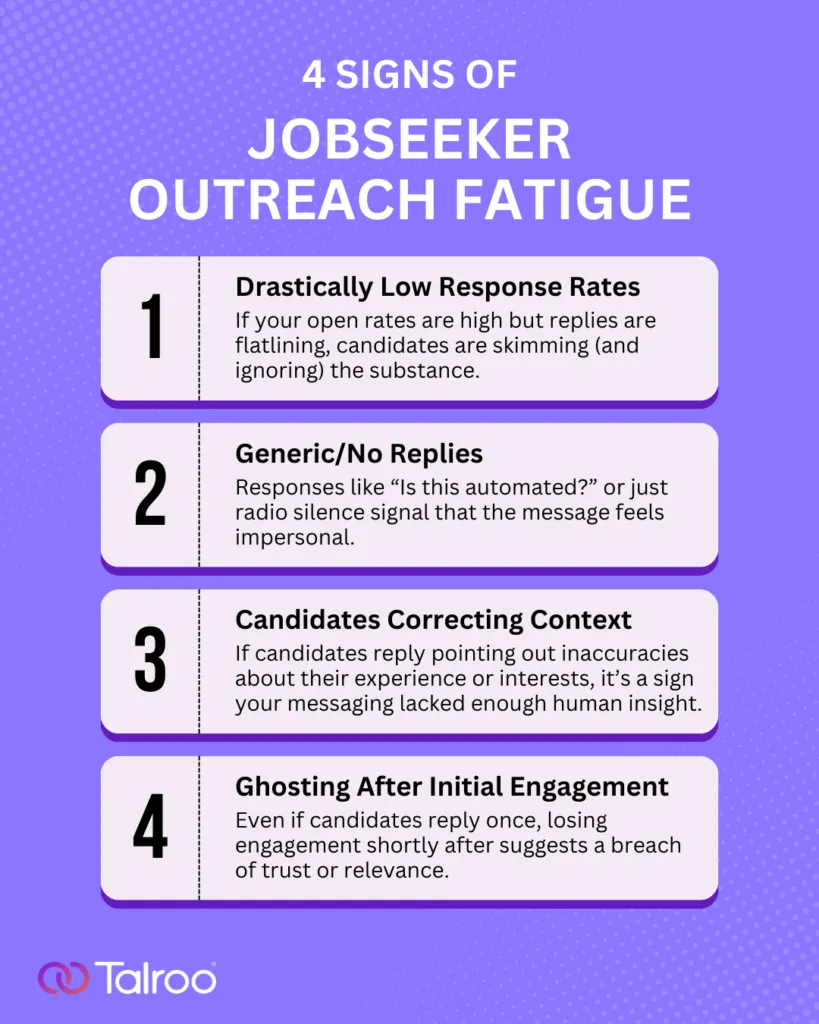
Before you can fix outreach, you must recognize when it’s failing. Here are clear signs your messages aren’t resonating:
If your open rates are high but replies are flatlining, candidates are skimming (and ignoring) the substance.
Responses like “Is this automated?” or just radio silence signal that the message feels impersonal. Recruiters in industry forums report that AI-generated outreach can see response rates as low as a third of human-written messages.
When candidates reply pointing out inaccuracies about their experience or interests, it’s a sign your messaging lacked enough human insight.
Even if candidates reply once, losing engagement shortly after suggests a breach of trust or relevance.
AI can compose coherent text, but it doesn’t inherently understand context unless given precise, human-crafted prompts. If your prompts are superficial, you get superficial output. This mirrors the workslop phenomenon: content that looks complete but doesn’t reduce cognitive load or deliver real value.
With so many recruiters using the same AI templates and automation scripts, patterns emerge. Candidates begin to recognize the style, cadence, and structure of AI-generated outreach—and tune it out.
AI can write fluent language, but fluency doesn’t equate to sincerity. Without personal insight, messages feel interchangeable and hollow.
Once candidates perceive outreach as inauthentic, trust drops. And trust is a core driver of candidate engagement.
Good news: AI doesn’t have to be the enemy of authentic communication. When used thoughtfully, it can amplify real human connection rather than replace it. Here’s how.
AI is only as good as the guidance it receives. Before generating outreach:
Use these insights as precise inputs in your AI prompt. This trick can dramatically improve relevance.
Forget the “{First_Name} + job title” formula. Instead, reference:
Example snippet: “I noticed you led the migration to X architecture at [Company]. We’re tackling similar scaling challenges and would value your perspective.”
This kind of contextualization signals genuine attention and effort.
Don’t send messages straight from the AI generator. Instead:
This preserves speed without sacrificing quality.
Think of AI as your drafts assistant, not the storyteller.
This hybrid approach gives candidates both clarity and authenticity.
Recruiting isn’t just outreach; it’s relationship building. Instead of letting candidates guess whether the message was AI-generated, you can be transparent about using AI tools to assist you while making clear that the engagement is led by a human recruiter invested in their career.
Rather than ending with a generic “Interested?” close, invite dialogue:
“Given your experience with X, what’s one skill you’re most excited to apply next? I’d love to hear your thoughts.”
Open-ended questions can increase response rates and shift the conversation from broadcast to interaction.
AI tools will only become more sophisticated. But the fundamental truth remains: candidates respond to relevance, connection, and respect. Tools that automate outreach without preserving human judgment are bound to produce noise, not signals.
Research on generative content shows that pervasive use of automated work without thoughtful oversight can erode trust and productivity in professional communications. The same effect plays out in candidate outreach: too much shiny automation leads to hollow messaging.
At the end of the day, AI should enhance recruiter empathy, not erode it. Use it to streamline routine tasks, yes, but never at the expense of the candidate’s experience. Because when your outreach feels human, it gets human responses.
If you enjoyed this article, you might also like:
Recent Posts
Categories
Tags