Recruiting the right talent in today’s competitive job market requires balancing three critical factors: time, cost, and quality. Known as the recruitment triangle, these principles guide every hiring decision. Whether you are filling entry-level positions or senior leadership roles, understanding this triad helps organizations make smarter, more efficient hiring choices.
What Are the Principles of Recruitment?
Recruitment is the process of attracting, selecting, and onboarding the best candidates for a role. The three core principles—time, cost, and quality—form a framework for evaluating trade-offs:
Balancing these factors is crucial because prioritizing one often impacts the others. For instance, moving quickly to hire top talent may increase costs, while cutting expenses might extend the hiring timeline.
Understanding the Recruitment Triangle
The recruitment triangle visually represents the interplay between time, cost, and quality:
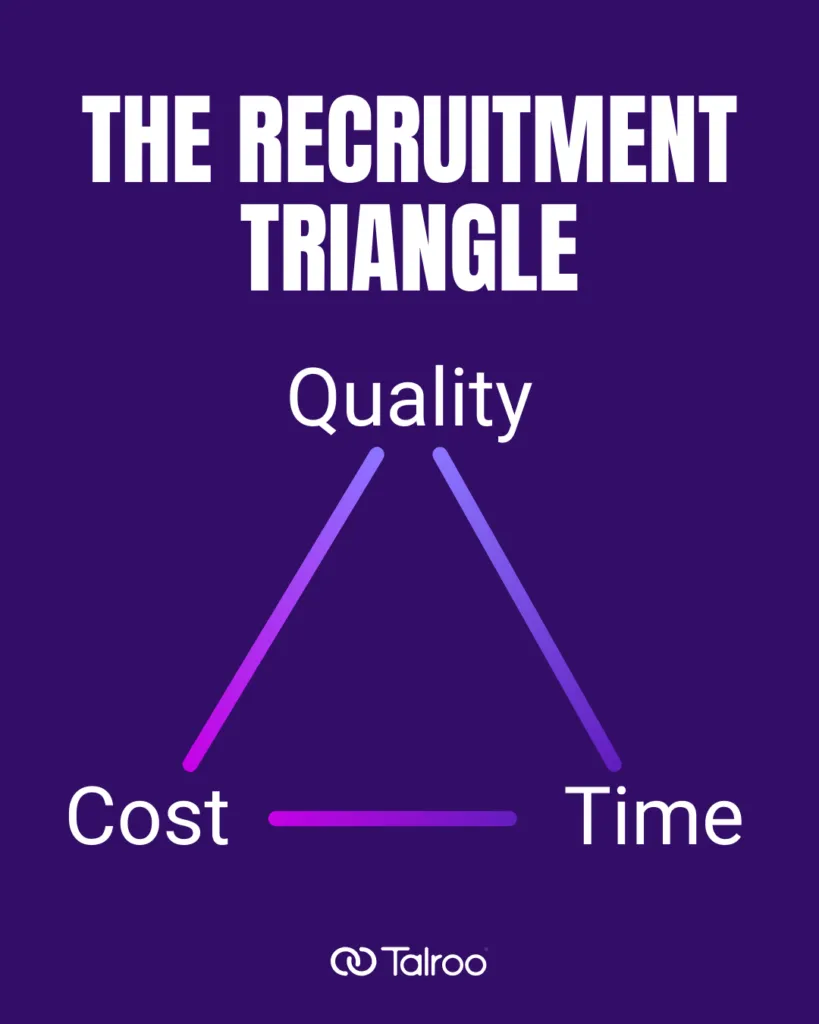
This triangle illustrates that optimizing all three at once is nearly impossible. Hiring managers must prioritize based on organizational needs and market conditions.
Example: If you prioritize speed and quality, costs will likely increase due to premium sourcing, referral incentives, or specialized recruiting platforms. Conversely, limiting costs might require extending timelines or compromising slightly on candidate experience.
How to Balance Time, Cost, and Quality in Modern Recruitment
Here’s how modern organizations can strategically manage the triangle:
One Practical (Hypothetical) Example: A retail company needed to fill 50 frontline roles in one month. By using a combination of automated job posting optimization and targeted advertising via Talroo, they reduced average time-to-hire from 45 to 25 days while keeping cost-per-hire within budget.
Common Recruitment Challenges and Trade-Offs
Even with advanced tools, hiring teams face trade-offs:
Understanding these trade-offs and being transparent with stakeholders helps set realistic expectations and improves overall hiring outcomes.
Key Metrics for Measuring Recruitment Success
Data-driven hiring improves efficiency and effectiveness. Key metrics to monitor include:
Tracking these metrics helps optimize the triangle and continuously improve hiring outcomes.
*Source: Winning the Talent Race: Key Insights from the 2025 Global Recruitment Report
FAQs About Recruitment Principles
Q: Can I optimize time, cost, and quality simultaneously?
A: While perfect balance is rare, using analytics, automation, and targeted strategies can improve outcomes across all three areas.
Q: How does Talroo help manage the recruitment triangle?
A: Talroo’s performance-based advertising allows precise targeting to reach high-quality candidates faster, keeping costs under control.
Q: What’s the best approach in a tight labor market?
A: Prioritize quality hires for critical roles, use data-driven sourcing, and maintain speed in your process to stay competitive.
Final Thoughts on Time, Cost and Quality
Time, cost, and quality are the pillars of effective recruitment. Understanding and managing these principles is more important than ever in the 2024–2025 labor market, where competition for talent remains high and candidates have multiple options. By leveraging data, technology, and strategic planning, hiring teams can optimize the recruitment triangle and secure the talent organizations need to succeed.
If you enjoyed this article, you might also like:
Faster & Smarter Hiring: Measuring Time to Fill, Time to Hire, and Time to Start | Talroo
Winning the Race to Hire: Speed as a Competitive Edge | Talroo
Tagged with
Recent Posts
Categories
Tags